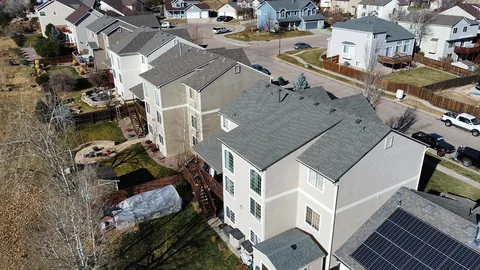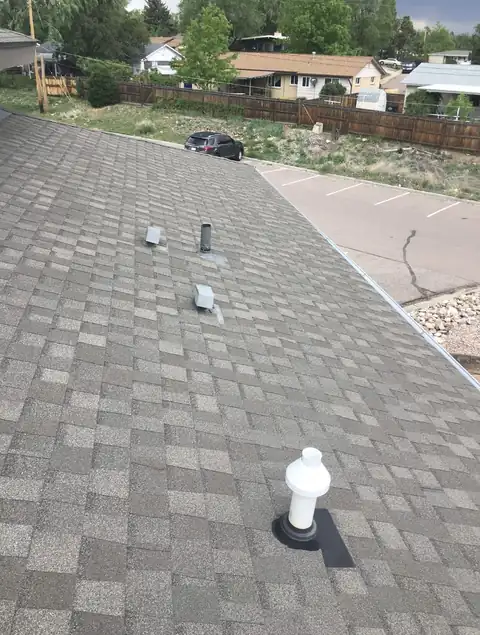
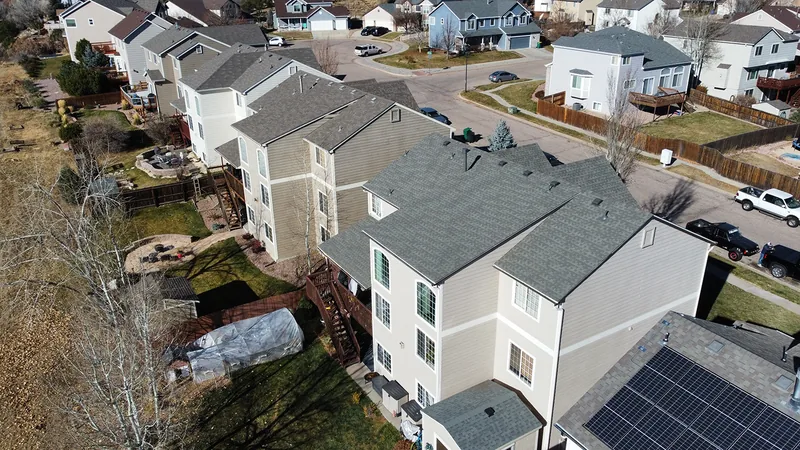
A lighter shingle does run cooler in the afternoon sun than a dark one. Whether you'd notice it on your power bill depends more on your attic than on the color you pick.
How much cooler is a light roof, really?
Good numbers on this come from Berkeley Lab's Heat Island Group. On a summer afternoon, they measured a black roof at 54 degrees Fahrenheit warmer than a white one next to it. A white roof that reflects 80 percent of sunlight stays about 55 degrees cooler than a gray roof that reflects 20 percent (Berkeley Lab).
Those gaps are big. They're also about white roofs, and the same page points out that white is popular mainly on low-slope roofs you can't see from the street. Few people want a white shingle roof on a brick ranch in Halls.
For a sloped house roof, the more useful comparison is a regular shingle against a cool-color version of the same shade, which is what the next section covers.
What's a cool-color shingle?
It's a shingle in an ordinary color that's built to bounce back more of the sun's near-infrared light, the part you can't see that carries a lot of the heat. Berkeley Lab and Oak Ridge National Laboratory, just up the road, worked with manufacturers to make cool-colored products for pitched roofs, asphalt shingles among them.
Berkeley Lab's example: a cool-colored roof at 35 percent solar reflectance stays about 22 degrees cooler than a conventional roof at 10 percent. Solar reflectance is the share of sunlight a surface sends back, on a scale of 0 to 1.
The Cool Roof Rating Council keeps a directory of rated roof products. If a shingle is sold as cool, you can look it up there and compare it with the one you had in mind.
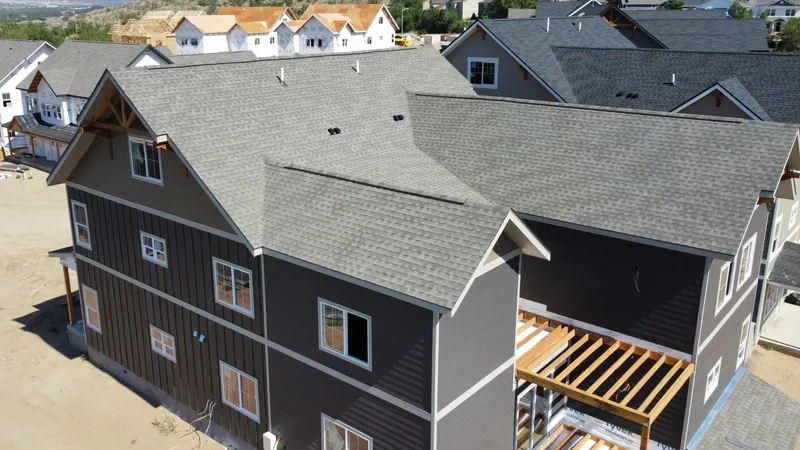
Does color change the attic?
Some. A cooler roof surface means less heat soaking into the decking. If the attic has good intake at the eaves, exhaust up high and enough insulation on the floor, a lot less of that heat makes it into your rooms in the first place. If the attic is short on air, a lighter roof helps a little, but the heat still builds up there with nowhere to go. We go through the attic side in what summer heat does to a roof and the attic under it.
Do light roofs show algae?
The black streaks that run down some roofs come from blue-green algae. Malarkey names the species, Gloeocapsa magma, and says dew, humidity and sun together give it what it needs. In very humid places, it says, the streaks can show up as soon as 3 years after a roof goes on (Malarkey).
Dark streaks on a light gray roof are easy to spot from the street. On charcoal, they're harder to see but just as present. Either way, ask for algae-resistant shingles. They carry copper granules that release copper ions and keep the algae from getting started. And don't pressure-wash a streaked roof. Malarkey warns it can knock granules loose from the shingles.
Does your HOA get a say?
If your neighborhood has an HOA, probably. Many keep a list of allowed shingle colors, and some name the exact product lines. Get that list before you fall for a sample. If you live in a subdivision in Farragut or anywhere else with an HOA, it's the first thing to ask for. Bring the list with you when you look at samples, so you're only choosing among colors you can actually use.
Our take
Pick the color that looks right on your house, and buy it algae-resistant. If a cooler attic is the goal, we think the money does more in vents and insulation than in a lighter shade, so start there and then ask whether a cool-color version of the shade you already like is available. Our post on picking a shingle color for your house style helps with the first part, and you can compare shingle lines on our products page.
Questions
Is a black roof a bad idea here?
Not by itself. It runs hotter on the surface, so the attic under it matters more. If the vents and insulation are right, pick the color you like and buy it algae-resistant.
Do cool-color shingles cost more?
Ask for both prices on the same quote, the cool version and the standard one, so you can see the difference for your roof.